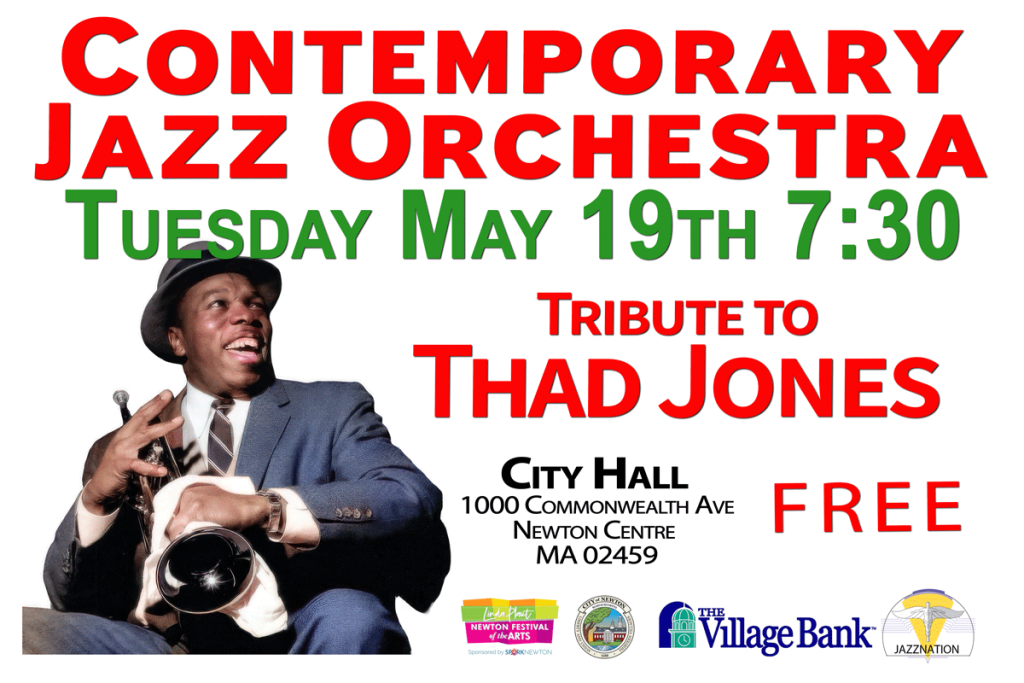
Contemporary Jazz Orchestra East
”I’ve been waiting for a long time to get my big band back together. There is nothing like a modern, no-holds-barred, blowing big band swinging great music!”
Christopher Pitts, saxophone and CJO director: “A saxophonist deeply immersed in the total jazz tradition.” JazzTimes critic Willard Jenkins
“It was the kind of music that makes one feel confident about the future of jazz.” The Detroit News
Steeped in Post Bop and Blues, Detroit saxophonist Chris Pitts made Manhattan, San Francisco and Paris his homes before moving to Boston. His bands have always featured energetic rhythm sections and adventurous music. He has performed at major jazz festivals and clubs in North America and Europe and played with jazz notables: Thad Jones, Dizzy Gillespie, Frank Foster, Clark Terry, Phil Woods, Jon Faddis, Regina Carter, James Carter, Betty Carter, Kenny Garrett, Roy Brooks, Ralph Armstrong, Marcus Belgrave, J.C. Heard, Grover Washington Jr., and Ralph Peterson. He’s opened for Ornette Coleman and Art Blakey. While in SF, Pitts founded the 18-piece Contemporary Jazz Orchestra. The CJO played every Monday night at Jazz at Pearl’s in North Beach from 1995 until the closing of the club in 2003. The CJO released 3 recordings currently available on iTunes.
Entertainers Pitts has performed and/or recorded with include Aretha Franklin, Natalie Cole, Gladys Knight, The Four Tops, The Temptations, Martha Reeves, Lou Rawls, Bob Hope, Liberace, Henny Youngman, Lyman Woodard, Enchantment, The Floaters, The Dramatics, and even President Bill Clinton. Since moving to the Boston region, Pitts continues to perform and also produces various concert series, including the Newton Piano Summit and the Linda Plaut Newton Festival of the Arts, 2000-2024. A staunch advocate for the Arts and Culture, he served as the co-chair of the Newton Cultural Council.
So who was Thad Jones, and why is he considered an innovator?
Thad Jones’s arrangements were innovative on several levels simultaneously — harmonically, rhythmically, structurally, and in how he conceived the orchestra itself as an instrument. Here’s what set him apart:
Multiple lines, melodies, playing simultaneously, weaving seamlessly, building, with space for soloists, are a trademark of his arrangements. So is serious swing. He was also an amazing band leader who could pull energy out of people and make them swing like there was no tomorrow.
The big band as a small group
Perhaps his most conceptually radical innovation was how he thought about the ensemble. His works possess challenging harmonic complexity combined with an earthy, bluesy foundation, with the band functioning as a vehicle for the great soloists who passed through it. The Thad Jones–Mel Lewis Orchestra was famously described as a “small group with 16 members” — meaning the interplay had the intimacy and spontaneity of a quartet, not the regimented formality of a traditional big band.
Harmony that nobody else was writing
Jones’s vertically extended harmonies, with many chromatic alterations, were genuinely innovative in big band writing in the 1960s. His pianist Sir Roland Hanna, who played every note Jones wrote, said the Jones harmonies were the most sophisticated since Duke Ellington’s — and that they were “rarely ordinary.” In plain terms: he used dissonance boldly, but always with an underlying logic that made it feel inevitable rather than arbitrary.
Polytonality and polychords
His arrangements featured reharmonizations of jazz standards, employing polychords and altered tonal structures to refresh familiar melodies while maintaining rhythmic drive. In his later period especially, the use of unidentified polychords and the deliberate vacancy of the melody became tools for musical expression — creating tension and ambiguity that resolved in surprising ways.
Rhythm and melodic unpredictability
His charts stood out from the beginning for their quirky melody lines, complex rhythms, and dense harmonies — with an abundant use of dissonance and a relentless feeling of unpredictability. What sears the Thad Jones trademark in the ear is the depth of his art — what scholars have termed “a rhythmic adeptness and an ingenious thematic coherence.” His arrangements are full of life, often very complex, yet retain a playful exuberance that makes them memorable and enjoyable to hear, to learn, and to play.
Structural evolution over time
His arranging style evolved through three distinct periods: an early period rooted in Basie-style blues vocabulary and call-and-response between saxophones and brass; a middle period that explored symphonic sounds, suite-like forms, and elements of rock-jazz and funk-jazz; and a late period guided by a more comprehensive development of tension and release. This arc shows a composer who never stopped pushing.
Too advanced even for Basie
One telling measure of just how far ahead he was: when Jones was commissioned to write arrangements for his former Basie band in 1965, the charts proved — depending on who you ask — either too modern or too difficult for the Basie band to tackle. Rather than let them go to waste, Jones called up drummer Mel Lewis about starting a rehearsal band — which became the Thad Jones–Mel Lewis Orchestra, one of the most celebrated ensembles in jazz history.
In short, Jones achieved something rare: music that rewards the most sophisticated musicians and analysts while remaining viscerally exciting and bluesy enough to move any audience. That balance is the hallmark of the truly great arrangers — and why his charts are still performed worldwide nearly four decades after his death. More of his Bio below.
CJO Band Bios
Trumpets:
Douglas Olsen
Trumpet Douglas Olsen has been a free-lance trumpeter for over 25 years, performing jazz and world music. He plays solo and/or lead trumpet with many of New England’s top bands and has also been a featured soloist with Scary Pockets, Iguie Castrillo Latin Jazz Orchestra, Latin Logic, Vibra Tropical, Tommy Dorsey Orchestra, USAF Band of Liberty, Smithsonian Masterworks Jazz Orchestra, Berklee College of Music Faculty Bigband, Big Apple Circus, Aretha Franklin, and Little Anthony and the Imperials. Doug has recorded extensively on pop/rock, swing, jazz, and latin CD’s, including: The Brian Thomas/Alex Lee-Clark Bigband, The Ayn Inserto Jazz Orchestra, The Fernando Huergo Bigband, Felipe Salles’s Interconnections Ensemble, The New World Jazz Composers Octet, A Collective Directive, “Prozac Nation” by Bellevue Cadillac (featured on the “The Sopranos” and “Shallow Hal”), and jazz vocalist Michelle Mailhot’s “A Happy Madness.” Doug holds the full-time position of Instructor/Lecturer and Director of Jazz Studies at WPI in Worcester, MA and was the Director of Music in Medfield Public Schools for the last 25 years before then. Doug is a very active clinician and guest artist, with appearances at MIT, Berklee, Harvard, Umass Amherst and Dartmouth, WPI, URI, Brandeis, CCRI, and Bridgewater State College. Doug performs regularly with the BTALC Big Band, the John Almark Jazz Orchestra, and with his projects “Latin Bash” and the Doug Olsen Quintet.
Dan Rosenthal
Daniel Rosenthal is a Boston-based jazz trumpeter, composer, and educator with deep roots in both the New England jazz scene and American folk traditions. He grew up in a musical family in Guilford, CT, playing his first gigs at age 10 with the family band, and went on to build one of the region’s most distinctive careers as an improviser and bandleader.
Rosenthal has been a member of the Grammy-nominated jazz ensemble The Either/Orchestra since 2006, performing on stages throughout North America, Europe, and Africa. He is also a member of Charlie Kohlhase’s Explorers Club, Ayn Inserto’s Jazz Orchestra, the Fernando Huergo Big Band, and the Greg Hopkins Jazz Orchestra, and co-leads the Hofbauer/Rosenthal Quartet with guitarist Eric Hofbauer. He has shared the stage with Steve Lacy, Anthony Braxton, Joe Morris, Bob Brookmeyer, Medeski Martin and Wood, George Garzone, Miguel Zenón, Matt Wilson, and many others, and has performed with Ethiopian music legends Mulatu Astatke, Mahmoud Ahmed, and Getachew Mekurya.
Festival appearances include the Chicago Jazz Festival, Montreal Jazz Festival, Glastonbury Festival, Moers Festival, and Helsinki Festival. His recordings include his own Music in the Room, Mulatu Astatke’s Mulatu Steps Out, and the Either/Orchestra’s Mood Music for Time Travellers.
Rosenthal earned his B.A. and M.M. in jazz performance from New England Conservatory, where he studied with Steve Lacy, Bob Brookmeyer, John McNeil, and Jerry Bergonzi, and studied classical trumpet for four years with long-time Boston Symphony Orchestra principal trumpeter Charles Schlueter. He teaches Ear Training at Berklee College of Music and Alexander Technique privately.
Eli Block
Eli Block is a versatile trumpet player and educator based in Boston, Massachusetts. He performs regularly throughout New England with groups such as the BT/ALC Big Band, the John Allmark Jazz Orchestra, the Silver Arrow Band, and the Henry Godfrey Jazz Orchestra. Block has also shared the stage with legendary acts such as Frankie Valli and the Four Seasons, The Temptations, The Four Tops, Johnny Mathis, and the Grammy-winning 8-bit Big Band, as well as renowned artists including Dave Holland, Dave Douglas, Miguel Zenón, Ethan Iverson, and Antonio Sánchez.
Block holds a Master’s degree in Jazz Performance with academic honors from New England Conservatory (2020), where he was a member of the NEC Jazz Orchestra and a recipient of the NEC Beneficent Society Scholarship. He earned his Bachelor of Music in Trumpet Performance magna cum laude from St. Olaf College, winning the Senior Soloists competition and performing the Hummel Trumpet Concerto with the St. Olaf Orchestra. As a collegiate musician, he toured Argentina, Uruguay, Cuba, Spain, France, Italy, and across the United States.
A dedicated educator and member of the Jazz Education Network, Block was featured as a Visiting Artist at St. Olaf College in 2022, leading masterclasses and performing as a soloist.
Block also maintains an active career as an orchestra librarian, having served at the Boston Symphony Orchestra, Seattle Symphony, Boston Landmarks Orchestra, and as a Tanglewood Music Center Library Fellow.
Roger Diebold
Roger Diebold is a Rhode Island-born trumpeter whose deep roots in the jazz tradition have carried him from All-State ensembles and Lincoln Center to the stages of the Boston jazz scene. He has been playing trumpet since fifth grade, developing early as both a section player and soloist with a particular passion for mainstream and post-bop jazz.
As a high school musician, Diebold earned recognition at some of the most prestigious jazz showcases in the country, performing as a band member and soloist at the MENC All-Eastern Jazz Ensemble at Heinz Hall in Pittsburgh, competing at the Essentially Ellington High School Jazz Competition at Avery Fisher Hall at Lincoln Center in New York City, and participating in multiple Rhode Island All-State Jazz Ensembles.
At Duke University, Diebold led the Duke Jazz Ensemble’s trumpet section for four years under the direction of Paul Jeffrey and John V. Brown, performing alongside an extraordinary roster of jazz luminaries including Branford Marsalis, Delfeayo Marsalis, Terrence Blanchard, Nicholas Payton, Frank Foster, Steve Turré, Fred Wesley, Tito Puente Jr., T.S. Monk III, Ralph Peterson, Joanne Brackeen, John Clayton, Lonnie Smith, and Herlin Riley, among others.
A scientist, engineer, and medical device entrepreneur by profession, Diebold brings the same discipline and precision to his music that defines his professional life. He remains an active trumpet player committed to carrying forward the mainstream jazz tradition and sharing it with new audiences.
—
Trombones:
Pete Fanelli
Lead Trombone: Pete Fanelli, a Syracuse, New York native, is one of New England’s most active and in-demand trombonists. Pete can be seen performing a wide array of stylistically diverse music in and around Boston. His versatility enables him to share the stage with world-class groups such as the John Allmark Jazz Orchestra, Somerville Symphony Orkestar, and the award-winning Ezekiel’s Wheels Klezmer Band. Also at home in the theater pit, Pete has been an orchestra member for dozens of shows with theater companies across New England. Pete is also a sought-after collaborator on original music projects. Notable performance and recording credits include: Jim Guttmann’s Bessarabian Breakdown, the Gap Mangione Big Band, Dave Rivello Ensemble, BT/ALC Big Band, and Eastman Broadband. With the Eastman Broadband, he has participated in contemporary music festivals in Italy, Mexico and the U.S., as well as performed on recordings for the Bridge Records and Urtext labels. Pete’s passion for the study of brass playing and improvisation in its various forms translates to his love of teaching. He maintains a busy private teaching studio and has also lead middle, high school and collegiate workshops on the topics of trombone playing, klezmer music and jazz improvisation. A graduate of the Eastman School of Music in Rochester, New York where he received his degree in jazz performance, Pete has studied trombone and jazz improvisation under Mark Kellogg and Dr. Howard Potter at the Eastman school, as well as Steve Frank, Joe Colombo, Curtis Fuller and Hal Crook.
Artie Montenero
He performs regularly with the Kenny Hadley Big Band, the John Allmark Jazz Orchestra, and the Greg Hopkins Jazz Orchestra. He has performed in numerous U.S. tours with the Buddy Rich Band, the Artie Shaw Orchestra, the 70s pop band Tavares, and a Japan tour with jazz pianist Makoto Ozone. In the Boston area he has performed with Tony Bennett, Harry Connick, Jr., Josh Groban, Diana Ross, Natalie Cole, Liberace, Frank Sinatra, Jr., Paul Anka, and for Broadway shows including The Producers, Young Frankenstein, and West Side Story in Providence and Boston theaters. Artie has recorded with the Allmark, Hopkins, and Kenny Hadley Big Bands, and also on recordings with Greg Abate, Ronnie Rose, and with Boston’s White Heats Swing Orchestra on the movie soundtrack to Dick Tracy.
Jeff Galindo
Born in San Francisco, California, Jeff Galindo attended Berklee College of Music in Boston, Massachusetts on scholarship after high school. He also studied with Hal Crook, Jerry Bergonzi, and George Garzone with grants by the National Endowment of the Arts and began freelancing in the Boston area. His experience includes tours of Europe with Phil Woods and Japan with Makoto Ozone as well as tours with the Artie Shaw Orchestra, Irving Mayfield and the New Orleans Jazz Orchestra, and Robin McKelle. Jeff toured the world as the Trombonist and Musical Director with Esperanza Spalding. Jeff has performed with such notables as Chick Corea, Clark Terry, Joe Lovano, George Russell, Slide Hampton, and Johnny Griffin. He has also performed with Gunther Schuller, Ray Charles, Aretha Franklin, Jerry Bergonzi, Bobby Shew, The Boston Pops Orchestra, and the Village Vanguard Jazz Orchestra among many others. In Boston, Jeff performs regularly with the Greg Hopkins Big Band and Nonet,, The Galindo/Phaneuf Sextet (with which he has released a new cd “Locking Horns” in 1998 and won Boston Magazines “Best of Boston” for a jazz group in 1999, plus just released a new cd called “Talkin’ Horns in 2013), his double quartet with George Garzone, and in Quartet and Trio settings. He is currently one of the top freelancing trombonists in the Boston area. Jeff has an extensive private teaching schedule. Jeff is in high demand as a guest artist and clinician, having done so in many high schools and universities in the U.S., Canada, and Europe.
Peter Cirelli
The bass Trombone is critical in any orchestra and Peter has established himself as the go-to guy in the region. Respected for his lyrical style, Peter Cirelli anchors the brass section. After living and working in Sao Paulo, Brazil, he has been a freelancer in the Boston area since 1983. While playing in jazz, Broadway shows, symphony orchestra and chamber groups, he has worked with the big bands of Greg Hopkins and George Russell, including recordings with Russell on Blue Note Records. Performances with Dave Brubeck, Sammy Davis Jr., Aretha Franklin, Stevie Wonder, Joni Mitchell, Natalie Cole and many others. He has taught music at Phillips Academy in Andover since 1986.
—
Saxophones:
Sam Spear
Sam Spear is a Boston-based saxophonist, composer, and music educator known for her versatility across jazz ensembles and her commitment to music education. She performs regularly with groups such as the Imagine Orchestra directed by Bill Banfield, the Michelle Tucker Quintet, the Mad Monkfish Orchestra, and the New England Jazz Collaborative. Spear also leads her own ensemble and has composed works performed by the Portland Jazz Composers Ensemble and the Berklee Concert Jazz Orchestra. In academia, Spear serves as an assistant professor in the Contemporary Writing and Production Department at Berklee College of Music. She is also part of the jazz studies faculty at the New England Conservatory’s preparatory division and is an affiliate artist at the Massachusetts Institute of Technology.
Jared Sims
Jared Sims is a saxophonist, multi-instrumentalist, and educator born and raised in Virginia FITC who performs on all of the saxophones as well as clarinet and flute. Syos He has toured throughout the United States and in Europe, South America, and Asia, Syos headlining venues in Bangkok, Kuala Lumpur, New York, Boston, Washington, Seattle, and Pittsburgh.
Sims has performed and recorded with an array of artists, including Rufus Reid, Matt Wilson, Han Bennink, Cecil McBee, Bob Brookmeyer, Soulive, Stefon Harris, The Temptations, Anat Cohen, Dave Liebman, Four Tops, Oteil Burbridge, the 10,000 Maniacs, and Noel Gallagher. Origin Records He has also performed with large ensembles, including the Rhode Island Philharmonic, the Artie Shaw Orchestra, and the Jimmy Dorsey Orchestra, Origin Records and has appeared at major festivals, including the Montreal Jazz Festival, Rochester Jazz Festival, and the Thailand International Jazz Conference.
Sims studied jazz and improvisation at the New England Conservatory, where he had the opportunity to work with George Russell, Gunther Schuller, and Ran Blake. Azsamadlessons He later earned a doctorate in classical woodwind performance from Boston University, with primary research focused on composer Luciano Berio’s Sequenza pieces.
As a bandleader, Sims has an impressive discography of more than ten albums as a leader, All About Jazz including the jazz quartet album Against All Odds (Origin, 2022) and the funk project Duochrome’s Sky View (Vintage League Music, 2022). His other recorded work includes music for theme parks, television commercials, and video games. Origin Records
Currently the Director of Jazz Studies at West Virginia University, Sims has also taught at the University of Rhode Island, University of New Hampshire, Boston University, and Southern New Hampshire University. Origin Records Music Republic Magazine calls him “one of the most exciting saxophonists and bandleaders heard in a long time.”
Rick DiMuzio
Jazz saxophonist, composer, and educator, has performed concerts and clinics throughout the United States, Europe, Central and South America, and Asia. In addition to leading ensembles under his own name, he performs regularly as a sideman with the Greg Hopkins Jazz Orchestra and Quintet, Bert Seager, Fernando Huergo, Phil Grenadier, Leo Blanco, and Kevin Harris. He has played or recorded with such artists as David Liebman, Steve Grossman, Bill Perkins, Jaleel Shaw, Jerry Bergonzi, Kenny Wheeler, Conrad Herwig, Lage Lund, Danilo Perez, James Williams, Leo Genovese, Esperanza Spalding, Terri Lyne Carrington, Roger Humphries, Francisco Mela, John Hollenbeck, and Jamey Haddad, among others.
In addition to his performing career, Rick has served as a Professor at Berklee College of Music for the past 25 years, where he has taught courses in ear training, improvisation (Thematic Development), saxophone, jazz composition, and ensemble. From 2005-2020, he co-directed the Five Week Summer Jazz Workshop ensembles with Terri Lyne Carrington. He is a former faculty member of New England Conservatory, Truman State University (MO), and Clarion University of Pennsylvania. Rick earned his doctorate in jazz composition from New England Conservatory, a master’s degree in jazz performance from the Eastman School of Music, and a bachelor’s degree from Indiana University of PA. Past teachers include Bob Brookmeyer, Jerry Bergonzi, George Garzone, Bill Dobbins, and Rayburn Wright. Time Travelers is Rick’s second album as a leader.
Philippe Crettien
Philippe Crettien, born in the South of France, son of French diplomats, grew up primarily in North Africa, the United States and England. Raised in a musical family, he was exposed at a young age to an eclectic array of music. He studied piano and the alto saxophone in High school while attending the French Lycee in London. After listening to John Coltrane, Wayne Shorter and Sonny Rollins switched to the tenor saxophone. He attended Berklee College of Music and earned a BA in Professional music. Studied with Andy MGee, Joe Allard, Joe Viola, Charles Banacos, Jerry Bergonzi, Kenny Werner and Hal Crook.
After graduating from Berklee, he performed and recorded with Blues Singer Jelly Belly, Trudy Silver, Bill Lowe, John Medeski, Andy Jaffe, Mario Pavone, Bob Gullotti, Andre Jaume, Rick Pekham, and Dave Zinno among others. Recorded three CD’s as a leader. Artistic director of the Toulon International Jazz Festival and director of the Toulon Jazz festival workshops 1991-2000. Currently, he is the jazz band director at The Rivers School in Weston MA, and Jazz chair at The Rivers School Conservatory.
Nicholas Brust
Nicholas Brust (pronounced “Bruhst”) is a Boston-based jazz saxophonist, composer, and bandleader heralded as a premier saxophonist of his generation. Wielding a unique, incisive, and soulful voice as an improviser, he has established himself in the world of modern improvised music, finding his niche in the traditional jazz small-group format.
Brust has performed with numerous highly acclaimed musicians, including Gilad Hekselman, Roy Hargrove, Jimmy Owens, Steve Wilson, guitarist Ben Eunson, and Kristina Koller, appearing in her quintet at the 2020 NYC Winter Jazz Fest. He has taken the stage at Jazz at Lincoln Center, Wally’s Jazz Club, The Lily Pad, NEC’s Jordan Hall, and Eastman’s Kilbourn Hall.
Brust holds a Master of Music in Jazz Performance from New England Conservatory and a Bachelor of Music in Jazz Studies and Music Education from the Eastman School of Music. At NEC, he studied with Jerry Bergonzi, Frank Carlberg, Ran Blake, Donny McCaslin, and Miguel Zenón.
His recordings include the debut album Frozen in Time (Fresh Sound Records, 2020) and sophomore release Daybreak (Outside In Music, 2023). Frozen in Time received international critical acclaim from All About Jazz, Jazz Journal UK, Modern Jazz Today, and the Jazz Quad, among others. Alto saxophonist Will Vinson calls Brust’s playing and writing “evidence that the future of the alto saxophone is in good hands.”
Brust is currently on faculty at New England Conservatory and Elefante School for the Performing Arts, and maintains an active private studio.
—
Rhythm Section:
Mark Walker (Drums)
Grammy Award-winning drummer, percussionist, author, and educator Mark Walker began playing drum set at age 10 and played his first professional club, concert, and recording gigs barely out of high school. He has performed on many Grammy Award-winning albums and earned several Grammy nominations for his work with various artists, including Oregon, Donato Poveda, Paquito D’Rivera, and the Caribbean Jazz Project. He has performed and recorded extensively with Michel Camilo, Dave Samuels, Andy Narell, WDR Big Band, NDR Big Band, Eliane Elias, Lyle Mays, Dave Liebman, Cesar Camargo Mariano, Rosa Passos, and many more. Walker is a professor in the Percussion Department at Berklee College of Music. He also has served on the faculty at Drummers Collective in New York City and has conducted master classes, clinics, and workshops in South America, North America, and Europe, both as a solo artist and with various groups. His book World Jazz Drumming, which features recorded performances by Paquito D’Rivera, was released in 2009 to critical acclaim. He also wrote for the all-star instructional drum set book Killer Grooves.
Wes Wirth (Bass)
Wes anchors our rhythm section with depth, groove, and creativity. His mastery of multiple styles provides the essential heartbeat of the ensemble.Wes Wirth is a prolific composer, writing for his bass, guitar, and voice, and for many other collaborators. Wes’ unique style has been described as, “visually expansive, a hyperbolic sound-scape, sonically erotic, sensually inviting, and mysteriously tender.” Wes’ inspiration comes from observing, and participating with the elemental forces of nature, and the stunning diversity and cultural beauty in the world. This “music” provides a template for understanding our collective creativity, out-of-the-box thinking, and the connective elements of synergistic phenomena. Wes has recorded or toured with legends such as Chuck Mangione and King Sunny Ade and George Russell, innovators like, Hal Crook, and Yazhi Guo, drum masters Rakalam Bob Moses and Kenwood Dennard, and guitar giants Stanley Jordan, Vernon Reid, and David Fiuczynski.
Harold Charon (Piano)
Harold Charon is a pianist, composer, and performer from Havana, Cuba, based in Boston. He began piano lessons at age 5, with an education rooted primarily in classical training before expanding into Latin jazz and jazz.
At 18, Charon was selected by Cuba’s National School of Music to perform on a tour of Canada that included the Halifax Jazz Festival. He later received mentorship from Fred Hersh, Taylor Eigsti, Billy Childs, and the late Chick Corea. In Berklee he had the privilege of receiving private lessons from performer and composer Billy Childs.
In Cuba, Charon worked with a range of bands including Leo Vera, La Cruzada, and Los Clasicos. In 2016 he joined Janio Abreu and Aire D’Concierto, and later worked with Ruy Lopez-Nussa y La Academia, participating with both groups at the Jazz Plaza festival in Havana.
Now based in Boston, Charon performs regularly at venues including Wally’s Jazz Café, the House of Blues, the Middle East, and The Lilypad. His music draws on Latin, salsa, jazz, and timba — the Cuban genre rooted in son, salsa, American funk and R&B, and Afro-Cuban folkloric music. He has studied at Berklee College of Music, majoring in jazz composition and performance.
——————————————-
The CJO embraces the Post Bop Big Band tradition exemplified by Thad Jones, Charles Mingus, Oliver Nelson, Frank Foster, Gerald Wilson, and Gil Evans. These artists, following in the rich tradition of Duke Ellington, Count Basie and other greats, added many of the jazz innovations that evolved after Charlie Parker, Dizzy Gillespie and company established Bebop.
The CJO’s Mission is to:
- Showcase individual performers and give them the modern big band experience that is increasingly rare in today’s music community.
- Provide a forum for new composers and arrangers to experiment and hone their talents.
- Introduce new audiences to the depth and richness of this tradition.
- Showcase internationally recognized artists in the big band context.
More about Thad Jones:
Thad Jones (March 28, 1923 – August 20, 1986)
Thaddeus Joseph Jones emerged from the postwar Detroit jazz scene to become one of the most distinctive voices in American music — a trumpeter, cornetist, composer, and arranger whose influence on the modern big band tradition remains unmatched. Musician Guide
Born in Pontiac, Michigan, Jones grew up in a household where music was both a passion and a way of life. His brothers were pianist Hank Jones and drummer Elvin Jones, making the Jones family one of the most celebrated in jazz history. Inspired to play trumpet after hearing Louis Armstrong perform in nearby Detroit, Jones was largely self-taught, and by age thirteen, he was already studying technique on his own from instruction books. He was playing professionally by age sixteen, alongside Hank Jones and Sonny Stitt. Jazzgiants + 3
After serving in U.S. Army bands during World War II, Jones became a member of the Count Basie Orchestra in May 1954. His impact on the band was immediate and lasting. He was featured as a soloist on celebrated recordings including “April in Paris” and “Shiny Stockings,” but his main contribution to Basie’s organization was nearly two dozen arrangements and compositions — work that redefined what a big band could sound like. In 1957 Jones appeared with Basie at a command performance for Queen Elizabeth in London, an occasion he commemorated in his composition “H.R.H. (Her Royal Highness).” Wikipedia + 2
Even among fellow giants, Jones commanded extraordinary respect. Charles Mingus, upon hearing Jones perform in Detroit, declared, “I just heard the greatest trumpet player that I’ve ever heard in this life. He uses all the classical compositional techniques, and is the first man to make them swing.” Trumpeter Tom Harrell, equally awed, memorably described Jones’s improvisational voice as “like Louis Armstrong on acid.” Musician GuideJazzgiants
Jones left the Basie Orchestra in 1963 to become a freelance arranger and musician in New York City. In 1965, Jones and drummer Mel Lewis joined forces to create the Thad Jones–Mel Lewis Orchestra, an eighteen-piece ensemble that ultimately modernized the sound of big bands. Initially a rehearsal band, the group secured a Monday-night residency at the Village Vanguard that would last thirteen years. The orchestra became the embodiment of a “small group with 16 members” — Thad’s huge onstage presence and high-energy conducting style urging his players to give their all as both an ensemble and as soloists. Among the sidemen who passed through the orchestra were trumpeters Jon Faddis, Snooky Young, and Marvin Stamm; trombonists Bob Brookmeyer and Jimmy Knepper; and such reed players as Eddie Daniels, Pepper Adams, and Joe Farrell. Wikipedia + 3
Jones’s big-band arranging style was unique, especially for its dissonant voicings within a tonal context. He composed enduring pieces, including “Fingers,” “Little Pixie,” “Tiptoe,” and what became his best-known standard, “A Child Is Born.” JazzgiantsBlue Note Records
In 1978, Jones moved to Copenhagen, Denmark, where he formed a new band called Eclipse, composed for the Danish Radio Big Band, and taught jazz at the Royal Danish Conservatory. He was awarded an honorary Doctorate of Humane Letters from William Paterson University, where he had earlier taught arranging and led the big band, one of the earliest instances of a prominent jazz musician being offered a full-time professorship. Jazzgiants + 2
In February 1985, Jones returned to the United States to take over leadership of the Count Basie Orchestra following his former leader’s death, but had to step down due to ill health. He passed away in Copenhagen on August 20, 1986. Wikipedia
Thad Jones left behind a body of work that continues to define the modern big band idiom. His compositions are performed by ensembles around the world, and his harmonic innovations — rooted equally in bebop sophistication and an earthy blues sensibility — remain a benchmark for jazz arrangers and composers to this day.